Yo, what’s up everyone! I’m here as a supplier of induction welding equipment, and today we’re gonna dig into the topic of "What is the heat input of induction welding equipment?" Induction Welding Equipment
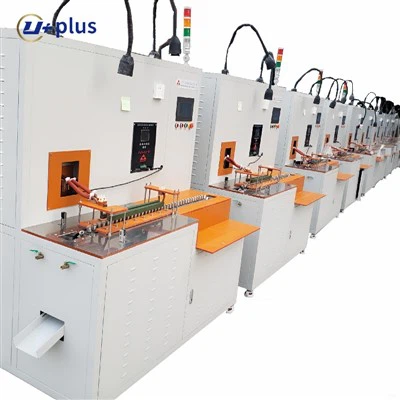
First off, let’s get a basic understanding of induction welding. It’s a pretty cool process. Induction welding uses electromagnetic induction to heat up a workpiece. The equipment generates an alternating magnetic field, and when a conductive material is placed in this field, it causes eddy currents to flow within the material. These eddy currents then produce heat due to the resistance of the material.
Now, let’s talk about heat input. Heat input is a crucial factor in induction welding. It’s basically the amount of heat energy that’s transferred to the workpiece during the welding process. Why is it so important? Well, if the heat input is too low, the materials won’t bond properly. The weld might be weak and prone to cracking. On the other hand, if the heat input is too high, it can cause all sorts of problems. The material might overheat, leading to distortion, changes in the material’s properties, and even damage to the surrounding areas.
So, how do we control the heat input in induction welding equipment? There are a few key factors.
The first one is the power of the induction generator. The power output of the generator directly affects the amount of heat that can be generated. A higher – power generator can produce more heat, which means a higher heat input. But we can’t just crank up the power willy – nilly. We have to consider the type and thickness of the material we’re welding. For thin materials, a lower power setting might be sufficient. But for thicker materials, we’ll need more power to ensure proper heating and welding.
Another important factor is the frequency of the alternating current. Different frequencies have different effects on the heat distribution within the workpiece. Higher frequencies tend to heat the surface of the material more, while lower frequencies can penetrate deeper into the material. So, depending on whether we’re doing a surface weld or a weld that requires deep penetration, we’ll choose the appropriate frequency.
The duration of the welding process also plays a role in the heat input. The longer the welding time, the more heat is transferred to the workpiece. But again, we need to find the right balance. If the welding time is too long, we risk overheating the material. And if it’s too short, the weld won’t be strong enough.
Let’s take a look at some real – world examples. Say we’re welding two pieces of stainless steel together. Stainless steel has a relatively high melting point and good heat – resistance properties. For a thin sheet of stainless steel, we might use a lower – power induction generator with a higher frequency. This way, we can quickly heat the surface of the stainless steel and create a good bond without overheating the material. The welding time might be just a few seconds.
On the other hand, if we’re welding a thick piece of copper, we’ll need a higher – power generator and a lower frequency. Copper is a good conductor of heat, so we need to make sure the heat penetrates deep into the material. The welding time might be longer to ensure that the copper reaches the right temperature for a strong weld.
Now, you might be wondering how we measure the heat input. Well, there are a few ways. One common method is to use thermocouples. Thermocouples are sensors that can measure the temperature of the workpiece during the welding process. By monitoring the temperature change over time, we can calculate the heat input. Another way is to use power meters to measure the power output of the induction generator and the duration of the welding process. Then we can calculate the total energy transferred, which gives us an idea of the heat input.
As a supplier of induction welding equipment, we understand the importance of getting the heat input right. That’s why our equipment is designed to be highly adjustable. We offer a range of power settings and frequency options to meet the needs of different welding applications. Whether you’re a small – scale workshop or a large – scale manufacturing plant, we’ve got the right equipment for you.
Our induction welding equipment is also equipped with advanced control systems. These systems allow you to precisely control the heat input. You can set the power, frequency, and welding time according to your specific requirements. This ensures that you get consistent and high – quality welds every time.
In addition, we provide comprehensive technical support. Our team of experts is always ready to help you with any questions you might have about heat input or the operation of our equipment. We can also offer on – site training to make sure you’re using the equipment to its full potential.
If you’re in the market for induction welding equipment, or if you have any questions about heat input and how it affects your welding process, don’t hesitate to get in touch. We’re here to help you find the best solution for your needs. Whether you’re looking to improve the quality of your welds, increase your production efficiency, or just want to learn more about induction welding, we’re the ones to talk to.

So, if you’re interested in discussing your requirements, feel free to reach out. We’ll be happy to have a chat with you and see how we can work together to achieve your welding goals.
CNC Spinning Machine References
- "Induction Welding: Principles and Applications" by Industry Experts
- "Heat Transfer in Welding Processes" from Professional Welding Journals
Taizhou U Plus Smart Technology Co., Ltd.
We are one of the most professional induction welding equipment manufacturers and suppliers in China, specialized in providing high quality customized service. We warmly welcome you to wholesale durable induction welding equipment for sale here from our factory. For quotation, contact us now.
Address: Room 202, 2nd Floor, No.29 Hubin Road, Chumen Town, Yuhuan City, Taizhou City, Zhejiang Province, China
E-mail: xiang@uplusmart.com
WebSite: https://www.uplusmart.com/
